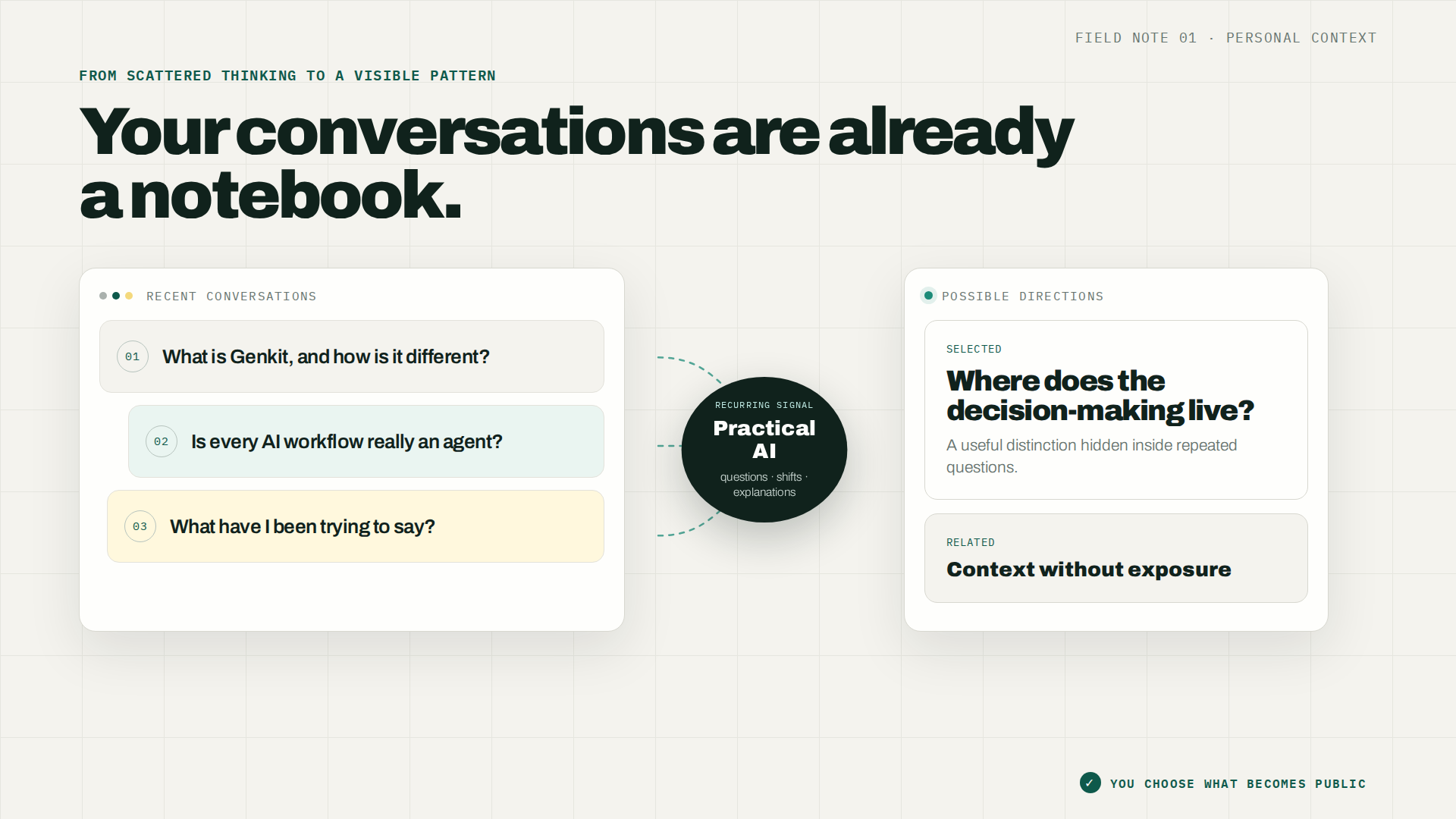
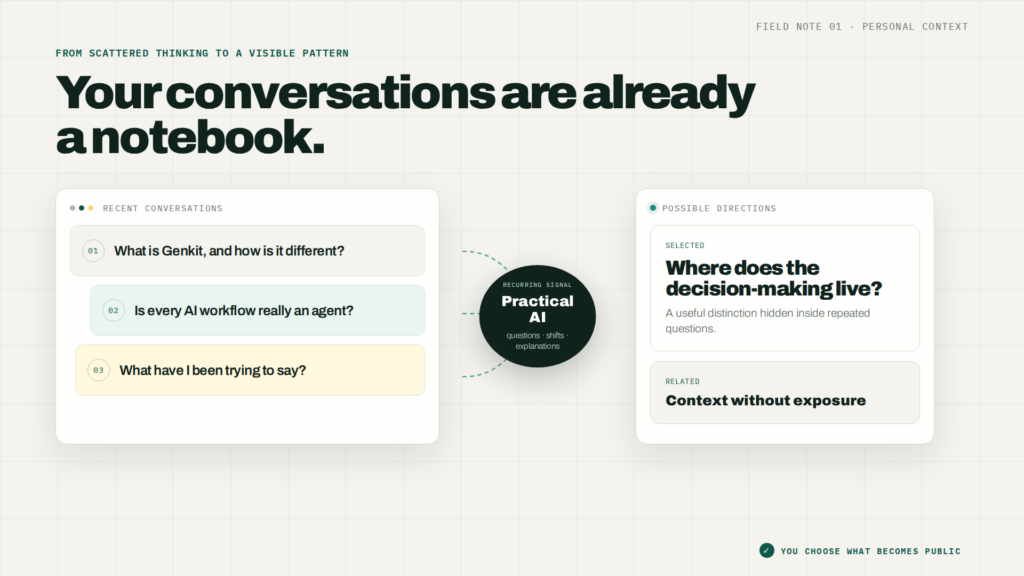
Our everyday questions, experiments and unfinished thoughts may already contain the stories we should be telling.
Category: Practical AI Systems | Estimated reading time: 6 minutes
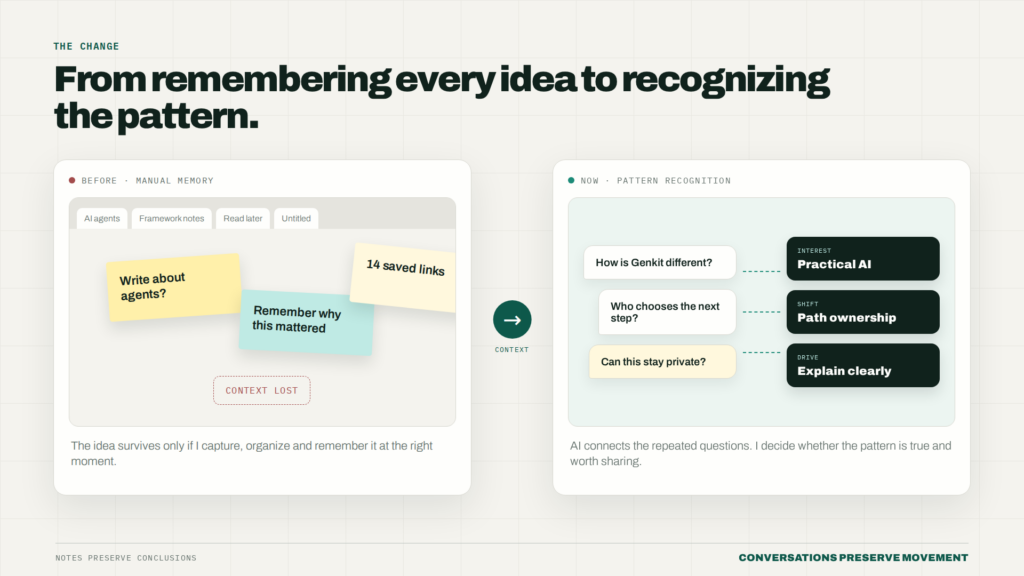
For a long time, I treated a blog idea as something I had to catch at exactly the right moment.
I needed to write it in a notes app, save the relevant links, remember why the question mattered and return before the energy behind it disappeared. If I failed at any of those steps, the idea usually became another forgotten tab or an unexplained sentence in a notebook.
Then I noticed something: many of my best ideas had already been recorded. They were sitting inside conversations.
Not as polished titles or completed outlines. They appeared as repeated questions, disagreements, follow-up explanations, experiments that failed and moments when I realized I had been looking at a problem the wrong way.
AI didn’t create those interests for me. It helped me see the pattern connecting them.
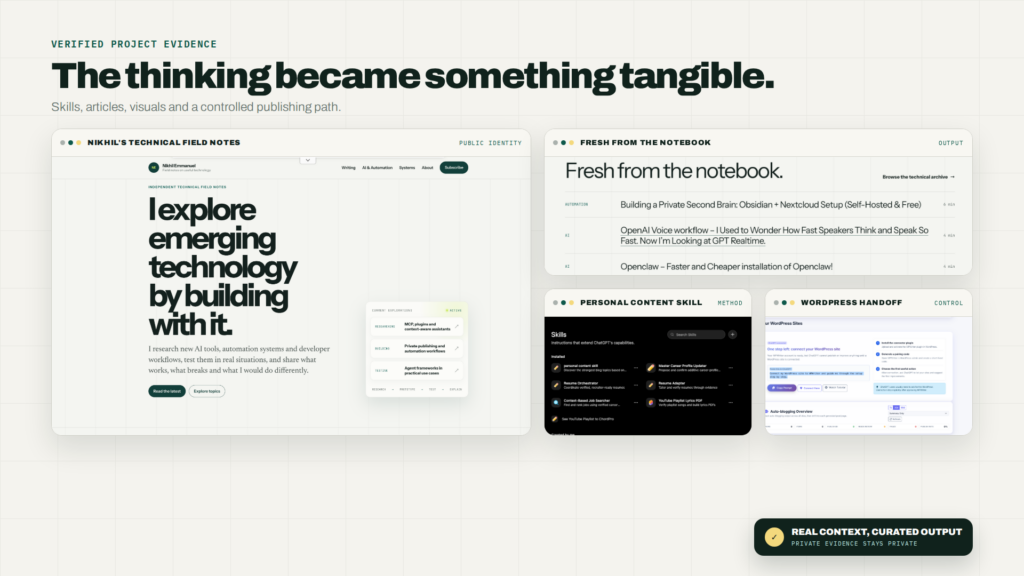
A conversation preserves more than a note
A note often captures the conclusion: Write something about AI agents.
A conversation captures the movement that produced it.
It may show that I started by calling every multi-step AI system an agent. Then I compared workflows, tool calls and autonomous decisions. I asked what actually changes when the model chooses the next action. Eventually, the useful distinction became clearer: the important question was who owned the path.
That journey became the basis for “Stop Calling Every AI Workflow an Agent.” The article was hidden inside the discussion long before it had a title.
The same thing happened when I tried to understand Genkit and LangGraph. At first, I wanted a straightforward comparison. I asked for a non-technical explanation, then an explanation for an amateur developer, and finally a more advanced architectural view.
Across those explanations, my question changed. The useful comparison wasn’t which framework had more AI features. It was which part of the application had become difficult enough to need a framework. That shift became “Genkit vs. LangGraph Is Usually the Wrong Question.”
If I had saved only the original question, I would have missed the more valuable story: how the mental model changed.
The pattern matters more than any single prompt
One conversation may be casual. A pattern across many conversations can say something meaningful.
When I looked across my own technology discussions, several themes kept returning: the boundary between workflows and agents, practical AI systems, self-hosting, context, privacy and human approval. I was also repeatedly trying to explain technical ideas simply without making them shallow.
None of that came from filling out a content-strategy questionnaire. It emerged from what I was already doing: asking questions, building small systems, correcting outputs and following an idea until I understood it well enough to explain.
This is where personal context becomes more interesting than ordinary content generation. Instead of asking AI to produce “ten trending blog ideas,” I can ask it to look for signals such as:
- Questions I have returned to more than once;
- Moments when my understanding changed;
- Connections between separate projects;
- Frustrations that point to a wider problem;
- Ideas I keep trying to explain to other people.
What AI can help us recognize
Many people have useful knowledge but don’t think of themselves as writers. They may not know what their “topic” is. Their experience feels too ordinary, too scattered or too difficult to organize.
But their conversations may already reveal it.
AI can help surface:
- What we are consistently interested in;
- Which problems we naturally try to solve;
- What experiences shaped our point of view;
- What we have been trying to say without naming it yet;
- What keeps pulling us back to the work.
That doesn’t mean every conversation should become content. It means our thinking no longer has to disappear simply because we didn’t label it as a future article when it happened.
From scattered context to intentional publishing
I eventually began shaping this into a blogging workflow. The simplest version can be described in five stages:
Capture → Connect → Choose → Create → Control
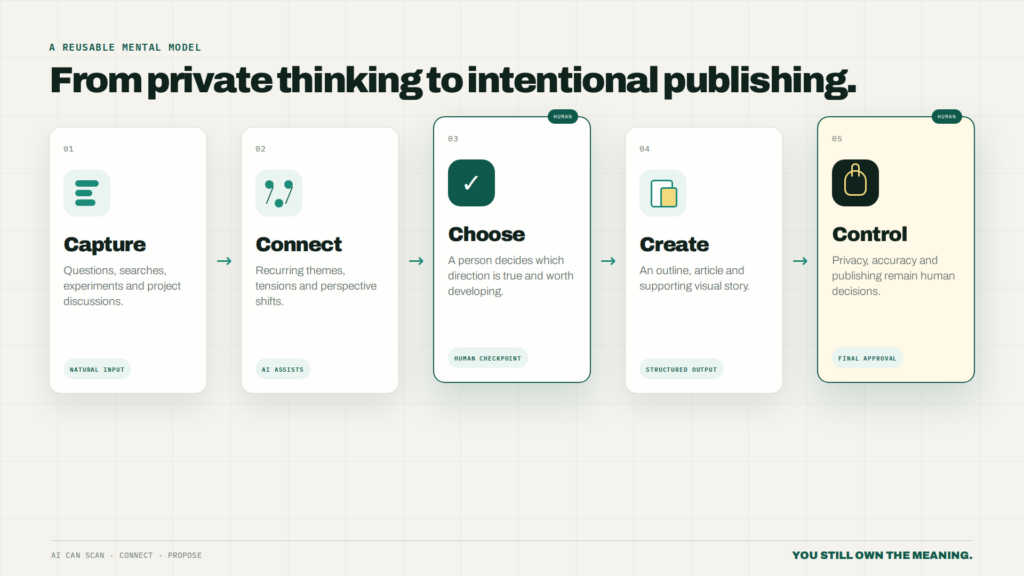
- Capture happens through questions, searches, experiments and project discussions.
- Connect is where AI looks for recurring themes, tensions and changes in perspective.
- Choose remains a human decision. I reject weak suggestions and select the direction worth developing.
- Create turns it into an outline, article and supporting visuals.
- Control protects the boundary between private context and public expression.
This last stage matters because a technically successful pipeline can still produce something I don’t want representing me. I corrected the system several times: topic selection had to happen before writing, visuals needed approval, generic designs were rejected, and publishing could never be automatic.
The workflow became better because I remained part of it.
Personal context is a signal, not source material
There is an obvious concern here: if AI reads personal conversations, does the article expose them?
It shouldn’t.
Private messages, family information, career details, credentials and personal correspondence do not become publishable simply because they helped reveal a broader interest. The system can use private context to notice a pattern while expressing the resulting insight through a generalized example.
Private career discussions might reveal an interest in how professionals move from software delivery into practical AI work. The public article can explore that transition without naming applications, recruiters or private messages.
The evidence stays private. The insight becomes useful.
This boundary also protects authenticity. AI should not invent a personal experience to strengthen a story, and it should not turn a passing question into a lifelong conviction. It can suggest a pattern. The person has to recognize whether that pattern is true.
The goal is not automatic content
It would be easy to describe this as a system that automatically converts conversations into blog posts. That description sounds efficient, but it misses the point.
I don’t want an endless stream of articles that happen to resemble my interests. I want help noticing which parts of my thinking may be valuable to someone else.
The difference is ownership.
AI can scan, connect and propose. I still decide what I believe, which examples are fair and when the work is ready. Sometimes the best result may be a better conversation rather than a published article.
That is why I think of this less as an automated writer and more as a personal context assistant: something that helps me return to my own thinking with better visibility.
Your next article may already exist
Most people don’t lack stories, interests or useful experience. They lack a reliable way to see those things together.
We used to depend on remembering the idea, opening a notebook and preserving it before daily life moved on. Notes are still valuable. Deliberate reflection is still valuable. But our conversations now contain another kind of record: not only what we concluded, but how we arrived there.
That record can help us understand what occupies our minds, what drives us and what we may be able to offer others.
The first question is no longer only, “What should I write about?”
It may be:
“What have I already been trying to say?”
In Part 2, I’ll explain how I built the personal-context blogging workflow, including topic discovery, privacy filtering, visual production, approval checkpoints and WordPress draft creation.
Discover more from Nikhil Emmanuel's Blog
Subscribe to get the latest posts sent to your email.